

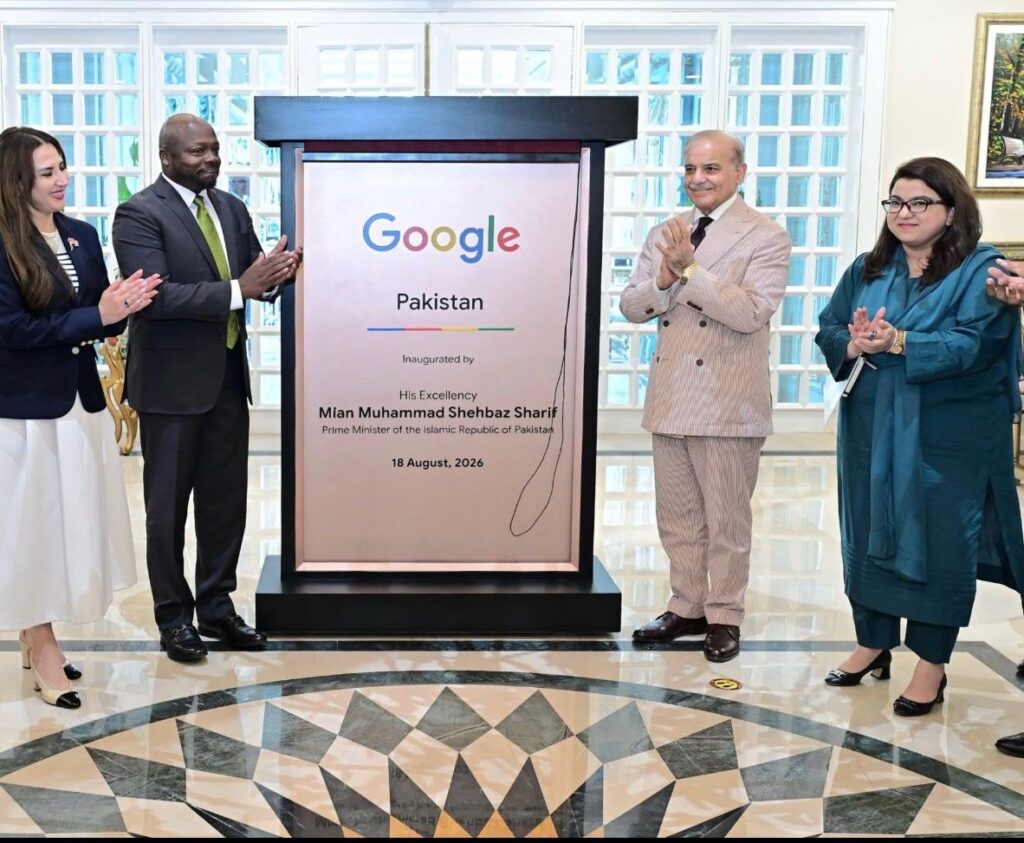
On August 18, 2026, Prime Minister Shehbaz Sharif inaugurated Google’s first local office in Pakistan, at a ceremony held at the Prime Minister’s House in Islamabad. It is a genuinely big moment for the country’s tech sector, and it deserves more than a one line celebration post. So here is what actually happened, what was promised, and what we at CyberWalk think ordinary users, students, and small businesses should keep in mind.
What happened
The Prime Minister met a nine member Google delegation led by Wilson L. White, the company’s Vice President for Global Affairs and Public Policy. Federal IT Minister Shaza Fatima Khawaja and US Chargé d’Affaires Natalie Baker were also present, and the two sides jointly unveiled a plaque to mark the opening (Islamabad Scene, Dawn, Express Tribune).
At the event, Wilson White said: “Over the past 10 years, we have contributed to more than Rs 3.9 trillion of economic activity for local Pakistani businesses as well as households in Pakistan, contributing to over 960,000 jobs, and this is just the beginning” (Islamabad Scene). This is not a new number invented for the occasion. It comes from Google’s own “Agay Barho: Empowering Pakistan’s Digital Economy” impact report, produced with Access Partnership and released in late 2024 using 2023 data (Access Partnership report, ProPakistani). Worth noting for accuracy: the original report itself puts the jobs figure at 965,000 (864,600 from Google products plus 100,400 from the Android app economy), so “960,000” is a rounded restatement, not a new independent count.
Google also said it has helped upskill over one million Pakistanis through career certificates and by working with schools and teachers. We have not yet found this specific figure in an independently published report and are flagging it as an unverified company claim rather than confirming it. If you come across the source, send it our way and we will update this post.
Google confirmed it will keep running its Chromebook assembly line in Haripur, Khyber Pakhtunkhwa, built with local partners Tech Valley, the National Radio Telecommunication Corporation, and Allied, targeting an output of 500,000 to 600,000 devices a year for local schools and regional export (App.com.pk).
The most talked about announcement, though, was this: Google will give free one year Gemini subscriptions to all students in Pakistan (Pakistan Today).
Why this actually matters
The Pakistani government has been publicly chasing a $30 billion IT export target since at least August 2025, when the Prime Minister directed authorities to draw up a roadmap to get there, after the sector closed the previous fiscal year at $3.8 billion, up 19 percent year on year (Arab News, Express Tribune). By FY2025-26 IT and ITeS export remittances had reached about $4.6 billion (PhoneWorld).
One thing worth flagging here, because it is exactly the kind of gap CyberWalk exists to point out: the $30 billion figure the Prime Minister repeats publicly does not match the government’s own formal target. In a written reply to the National Assembly, the IT Ministry stated the official goal is $25.1 billion in ICT exports by 2030, split between $15.3 billion from IT and IT enabled services and $9.8 billion from telecom (PhoneWorld). So there are effectively two numbers in circulation, a more ambitious one used at public events and a more conservative one filed as an official parliamentary answer. Neither is wrong exactly, but readers should know they are not the same target.
A company the size of Google formally putting down roots here, with a real office and a real local team, is a signal that at least part of that export ambition is being taken seriously by outside investors too. It also means decisions that affect Pakistani users, developers, and businesses may increasingly be made with local context in hand, not entirely from a regional office elsewhere.
For students, free access to a serious AI tool for a full year is not a small thing. Used well, it can genuinely help with learning, research, and picking up new skills. That part is worth being glad about.
What we think you should actually watch out for
This is CyberWalk, so we are not going to just leave it there. A few things worth keeping in mind as this rolls out.
Wait for the official sign up process, and be suspicious of anyone who beats Google to it. Whenever a big free offer like this is announced, fake “claim your free subscription here” links tend to show up on WhatsApp, Facebook groups, and SMS within days. Some will ask for your CNIC number, your card details, or your university login. As of this writing, Google has not published a public sign up process. Until it does, treat any link claiming to give you early or exclusive access as a scam, and do not enter personal information anywhere except Google’s own official pages.
A local office does not automatically mean local data storage. The announcement was about economic partnership, hiring, and training, not about where Pakistani user data is processed or stored. If that question matters to you, and as a digital rights minded reader it probably should, it is worth asking directly rather than assuming it has been resolved just because there is now a building in Islamabad.
Treat company reported numbers as company reported numbers. The Rs 3.9 trillion and 960,000 jobs figures trace back to a real, publicly available Google commissioned report, so they are not fabricated. But they are still Google’s own commissioned research about its own impact, not a government or independent audit. That is a normal thing companies do, and it does not make the number false, but readers deserve to know whose numbers they are reading.
The bottom line
This is a real and mostly positive development for Pakistan’s tech ecosystem, and the free Gemini access for students is worth taking advantage of once it is officially live. Just make sure “officially live” is the version you sign up for, not a copycat that showed up on your WhatsApp three days earlier promising the same thing faster.
We will follow up with a short guide once Google publishes the actual sign up process for the student Gemini offer, including how to tell a real link from a fake one.
Full Sources List:
- Radio Pakistan, “PM Shehbaz inaugurates Google’s Office in Pakistan”, Aug 18, 2026
- Dawn, “‘Big milestone’: Google’s local office inaugurated in Pakistan”, Aug 18, 2026
- Islamabad Scene, “Google opens first local office in Pakistan to support digital economy”, Aug 18, 2026
- Pakistan Today, “PM inaugurates Google office in Islamabad”, Aug 18, 2026
- Express Tribune, “Google opens doors to Pakistan’s digital future”, Aug 18, 2026
- Access Partnership, “Agay Barho: Empowering Pakistan’s Digital Economy” (Google-commissioned economic impact report, 2023 data)
- ProPakistani, “Google Claims To Help Generate Rs. 3.9 Trillion Economic Benefits in Pakistan in 2023”, Nov 7, 2024
- App.com.pk, “Narrowing digital skills gap can add Rs2.8 trn to country’s annual GDP in 2030: Google”, Sep 2024
- Arab News, “Pakistan PM calls for roadmap to boost IT exports to $30 billion”, Aug 2025
- Express Tribune, “PM wants $30 billion IT exports target achieved”, Aug 2025
- PhoneWorld, “Govt Aims to Boost ICT Exports to $25.1 Billion by 2030”, 2026